This return rate is called the Internal Rate of Return or IRR.
 When you invest in a solar system, you receive non-taxable dividends each year in the form of the cash that is no
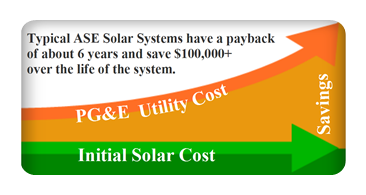
longer being paid to the utility company. The solar panel system has an internal rate of return higher than the yield achievable through most other investments (see table 1). In other words, to perform financially as well on a non-solar investment, you must receive a return equal to the solar IRR (on a tax-free investment or the Taxed Equivalent Rate on a taxable investment). If you invest the same amount as the net cost of a solar energy system, you need to make as much money to pay your utility bills as the solar electric system saves, plus enough more to pay any taxes on the investment returns.
When you invest in a solar system, you receive non-taxable dividends each year in the form of the cash that is no
longer being paid to the utility company. The solar panel system has an internal rate of return higher than the yield achievable through most other investments (see table 1). In other words, to perform financially as well on a non-solar investment, you must receive a return equal to the solar IRR (on a tax-free investment or the Taxed Equivalent Rate on a taxable investment). If you invest the same amount as the net cost of a solar energy system, you need to make as much money to pay your utility bills as the solar electric system saves, plus enough more to pay any taxes on the investment returns.
Table 1
| Electricity Rate Inflation* | Solar Internal Rate of Return | Taxed Equivalent Rate** |
| -2% | 12.8% | 20.4% |
| -1% | 14.0% | 22.3% |
| 0% | 15.1% | 24.1% |
| 1% | 16.3% | 25.9% |
| 2% | 17.4% | 27.8% |
| 5% | 20.9% | 33.3% |
*The historical average rate of inflation for electricity rates has been 2%. PG&E's "Average Retail Electricity Prices" have averaged 5.15% annual increases from 1980 to 2013, rising from 4.79 cents/kwh in 1980 to 21.00 cents/kwh in 2013 (source: http://www.eia.doe.gov/cneaf/electricity/epm/table5_6_b.html).
**assuming a marginal tax rate of 37.3%
- Other assumptions:
- Each peak kilowatt of solar panels will yield 1548 kwh of solar electricity per year.
- Electricity produced is zeroing 6600 kWh of use, at an average savings of $0.223/kwh.
- 4.275 kWp solar energy system costing $11,103 (after 30% federal tax credit, $2597/kilowatt), 30 year lifetime. Most solar panels are warranteed by their manufacturers for 25 years.
- Solar system has 0 value at the end of 30 years. In fact, the solar energy system will keep operating for many years after, producing free electricity.
Free Analysis
Such calculations show a solar energy system to be a good investment. There are some unknowns, such as the future price of electricity, and some variables, such as the homeowner's marginal tax rate and the size and cost of the PV system. The projection for your house will depend on your consumption patterns and tax status - contact us for a free personal analysis by phone at 831-333-1919 or by email at
 .
.
Examples
The following examples show some interesting results for two different scenarios.
A home averaging 550 kilowatt-hours per month (6600 kWh / year, as in Table 1) putting in a 2.28 kilowatt solar panel system will get economic benefits equal to a taxable investment paying 25.8%, assuming utility electricity rates rise at 1% (1/5 their recent rate and one-half their long-term historical rates). (See Table 2)
Table 2: Replacing Tier III and IV electricity
| Returns as a function of electricity rate inflation | ||||||||||||||||||||||||||||||
|
||||||||||||||||||||||||||||||
|
||||||||||||||||||||||||||||||
If the home averages 1000 kilowatt-hours per month, and rates rise at their historical 2%, a 2.28 kilowatt solar system will yield the equivalent of an investment paying 34.8%. (See Table 3) If you use a lot of electricity, even if rates DECLINE at 2% per year, a solar system is as good as a bank account paying 27.2%!
Table 3: Replacing only Tier IV electricity
| Returns as a function of electricity rate inflation | ||||||||||||||||||||||||||||||
|
||||||||||||||||||||||||||||||
|
||||||||||||||||||||||||||||||